



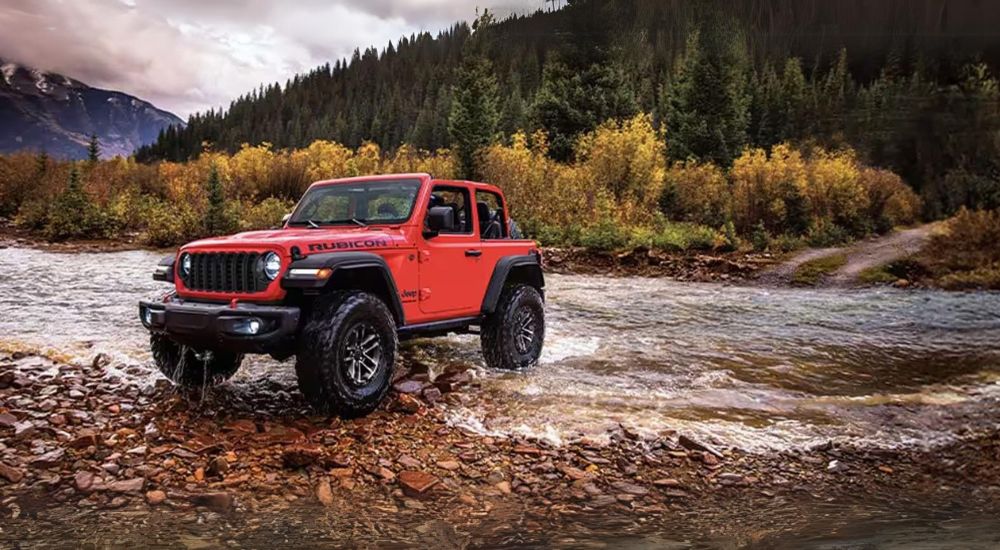
Off-road SUVs have become all the rage lately, but there are a few significant differences between the Jeep Wrangler and your average adventure rig. While other brands tend to roll out off-road-focused trim packages for their existing models, Jeep has taken a decidedly different approach to the Wrangler. The midsize Wrangler isn’t some average SUV masquerading as an off-road option. It’s meticulously crafted to tackle some of the toughest conditions your local trails can throw at it, with a purpose-built design that allows every trim to succeed on the road less traveled. From its impressive lineup of available four-wheel drive systems to its solid axle suspension and body-on-frame construction, there are many reasons to seek out a Jeep Wrangler for sale when hunting for your next off-road SUV. Let’s dive into the details and learn why the Jeep Wrangler has long been the SUV against which all other off-road models are judged.
Command-Trac, Selec-Trac, and Rock-Trac 4X4
Drivers might get caught up in comparing different styling packages, optional accessories, and comfort and convenience features, but an off-road SUV is only as good as its 4×4 system. Two-wheel drive is a non-starter if you hope to prevail through the mud, ruts, and rocks that come with off-road driving. But just because an SUV has 4WD doesn’t mean that it’s ready for every worst-case scenario you might encounter out on the trail. Luckily, Jeep hasn’t treated its 4X4 systems as an afterthought, providing the Wrangler with three distinct offerings that allow the SUV to serve as a reliable daily driver, mixed-use maestro, or dedicated off-road machine.
It all starts with Command-Trac, a part-time 4X4 system offering a balanced experience that seamlessly blends performance with efficiency and affordability. Command-Trac is equipped with four different settings that allow the SUV to adapt to varying conditions, from a 2WD High (2H) function that shifts all power to the rear wheels to maximize efficiency to a 4WD High (4H) feature that motivates all four wheels and maximizes traction by locking the front and rear driveshafts together. Command-Trac enables drivers to swap between 2H and 4H on the fly at speeds up to 55 mph. Standard on the Wrangler’s Sport and Willys trims, Command-Trac also includes a neutral setting designed for towing, and a 4WD Low (4L) mode that engages a low-range 2.72:1 gear ratio that’s perfect for slowly clawing through challenging trails and steep hills.
Selec-Trac represents a satisfying middle ground that maximizes off-road performance while still providing plenty of convenience as you go about your daily drive. The full-time 4WD system can be found on the Wrangler’s Sahara trim or added as an optional extra for the Sport S model. Selec-Trac offers the same 2H, Neutral, and 4L settings as Command-Trac, but ups the ante with two additional 4WD options. 4WD Auto quickly directs power where it’s needed the most, thanks to a center differential. This approach allows drivers to focus on the task at hand without the distractions that can come with constantly shifting between different 4WD settings. It is suitable for use on all surfaces, including paved roads. 4WD High Part-Time is the same as Command-Trac’s 4WD High setting, locking the axles to improve your chances of success when encountering a tough stretch of trail. Unlike 4WD Auto, it shouldn’t be engaged when navigating paved surfaces.
Finally, there’s Rock-Trac. Limited to the Wrangler’s range-topping Rubicon and Rubicon X trims, Rock-Trac 4X4 is made of sterner stuff and designed with all the heavy-duty gear you’ll need to scale a sheer rock wall or pick your way between massive boulders. From 4:1 low-range gearing and Tru-Lok electronic locking differentials front and rear to an electronic sway bar disconnect and a heavy-duty transfer case, Rock-Trac turns the already-capable Wrangler into the apex predator of the off-road world. The Wrangler’s Rock-Trac system has two versions: a standard part-time design, and an optional full-time upgrade that adds a road-friendly 4-Hi Auto mode with a center differential. Slow and steady wins the race, and it’s always a good approach when trying to conquer technical off-road obstacles. Rock-Trac’s 4WD Low with a 4:1 low-range gear ratio slows the wheels and ups the torque to power the Wrangler to greatness. The electronic front sway-bar disconnect improves the SUV’s articulation for maximum traction. The system also includes 2WD Hi, 4H, Neutral, and 4L modes, but it might not be the best option if you’re the type of driver who rarely ventures off the beaten path.
Solid Axles
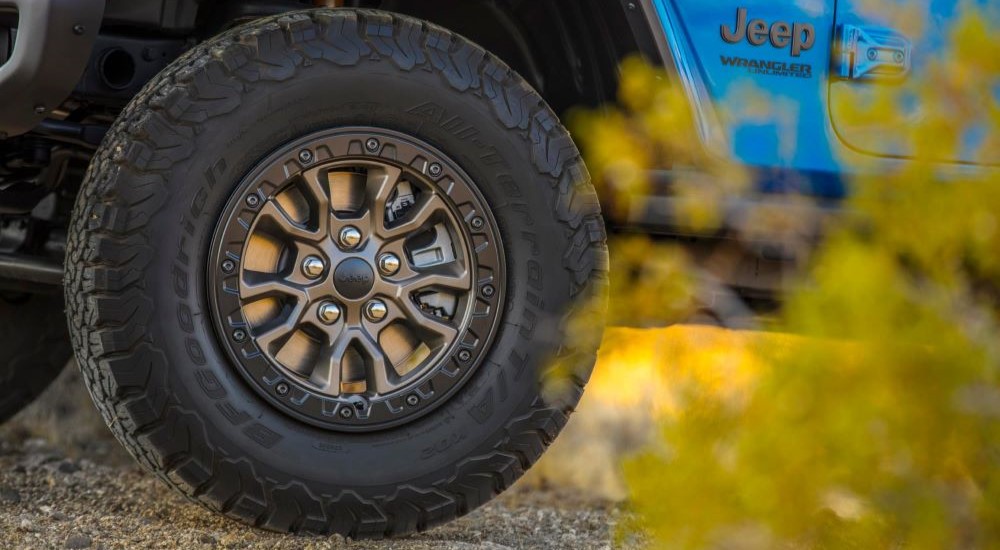
Jeep has teamed up with the automotive experts at Dana to outfit the Wrangler with some of the industry’s best axles, with even the SUV’s base Sport trim boasting Dana 30 front axles and Dana 35 rear axles. Known for their durability and generous aftermarket support, Dana axles can be found on many of the market’s best off-road models, and they make a huge difference in the Wrangler. Solid axles are made of sterner stuff than your average independent suspension, with fewer moving parts that can become damaged as you go about your journey. They can also accommodate larger tires and lower gearing, which makes them particularly well-suited to heavy-duty off-road tasks like rock crawling. The Sport trim can even be equipped with Dana’s premium 44 axles when adding the optional Trac-Lok limited-slip differential with the 3.73:1 gear ratio.
The other major benefit of a solid axle suspension comes down to articulation. The independent suspension in most modern SUVs sees each wheel paired with its own suspension system. This approach offers some benefits in handling and comfort, but it’s not ideal when the going gets rough. A solid axle, like the ones found in the Jeep Wrangler, connects two wheels with a rigid beam that basically acts like a see-saw. When a boulder, log, or other common off-road obstacle forces one wheel up, the wheel on the axle’s opposite side is forced down to maintain contact with the road. No matter how aggressive your off-road tires might be, they won’t gain any traction unless they touch the ground. A solid axle ensures you’re always maximizing contact as you tear through tough terrain.
Body-on-Frame Construction
Today’s SUVs aren’t created equal. The segment is easily one of the industry’s most diverse, from luxury rides to budget models and compact SUVs to three-row behemoths. A model designed to serve as a daily driver won’t get you too far when the going gets rough, while an off-road model might provide a harsh, overpowered ride for those who prioritize comfort and efficiency. There are a lot of factors you’ll want to keep in mind when shopping for your next off-road SUV, but few are quite as important as choosing between the body-on-frame and crossover construction method.
In the past, most SUVs were designed using the same body-on-frame construction method as most pickups. A body-on-frame vehicle sees the body bolted to a separate chassis, which offers some substantial benefits in terms of durability, towing, and repair costs. This approach worked well for decades, but the mid-1990s saw a new contender enter the field through crossover construction. A crossover SUV employs the same construction method used by most cars with a unibody design, which sees the body and chassis fused into a single component. Crossovers provide improved efficiency, a lower center of gravity, and increased comfort compared to their body-on-frame forerunners, which helped fuel unprecedented growth in the SUV segment.
The problem is that a unibody design isn’t really geared to off-road applications. A crossover SUV can’t handle the extreme twisting forces of rugged off-road use. It can even become irreparably damaged if the torsion becomes too much. Crossover models are also more difficult to repair and modify when compared to body-on-frame SUVs, and don’t offer the same level of underbody protection.
Jeep has long championed the body-on-frame method, and this decision has paid dividends when it comes to the Wrangler’s off-road reputation. The SUV’s body-on-frame construction allows the Wrangler to take a licking and keep on ticking while opening the door to some feats of towing and hauling strength. The body-on-frame SUV is also much easier to modify and lift, which is particularly important in a Jeep community where aftermarket upgrades are all part of the fun. A unibody SUV might also be totaled after a relatively minor collision, but the Wrangler’s body and frame can be independently repaired should the worst come to pass.
Wrangle a New Off-Road SUV at McHugh Chrysler Dodge Jeep Ram FIAT
While they might represent a few compelling points, the Jeep’s 4×4 systems, solid axles, and body-on-frame design aren’t the only three reasons to consider the Wrangler when you set out to find your next off-road ride. The Wrangler also offers the best approach, departure, and breakover angles in the midsize segment, which can make a huge difference when trying to clear obstacles or summit steep grades. These generous angles allow the Wrangler to tackle rugged terrain without worrying about incurring expensive underbody damage by giving the front and rear bumpers and the underbody a wide berth. If you really want an extra boost of confidence, consider seeking out one of the SUV’s Rubicon trims, which sees the Jeep graced with 33-inch tires and up to 10.8 inches of ground clearance (or 12.9 inches when investing in the optional Xtreme 35 package). No matter which model you choose, you’ll never lack off-road ability when you’re behind the wheel of the Jeep Wrangler.
Connect with us


- Chrysler Dealer
- Dodge Dealer
- Jeep Dealer
- Jeep Dealer Near Newark
- Jeep Grand Cherokee for Sale
- Jeep Wrangler for Sale
- New Jeep Cherokee Zanesville
- Ram 1500 for Sale
- Ram Dealer
- Ram Dealer Near Newark
- Uncategorized
- Used Car Dealership
- Used Jeep Compass for Sale
- Used Jeep Dealership
- Used Jeep for Sale
- Used Jeep Grand Cherokee for Sale
- Used Jeep Wrangler 4xe for Sale
- Used Jeep Wrangler for Sale
- Used Ram 1500 for Sale
- Used Ram 2500 for Sale
- Used Ram Dealership
- Used Ram for Sale
- Used Trucks for Sale